

Filter
What are you looking for?
Type
Tags
Sort

CATALYSTS
Mapping the scale and influence of global science philanthropy

INFLECTION
Rethinking research funding and evaluation in the agentic AI era

EFFORT
Estimating Funding Friction: Outcomes, Resource cost and Time

Undisciplined
Future models of funding and evaluating transdisciplinary research [completed]

Portfolios
Research funding landscape analysis [completed]

Peer Review
RoRI Atlas of Peer Review [completed]

PATHWAYS
Advancing Research on Research Use to Enhance Positive Impact

Narratives
The uses and evaluation of researchers’ narrative CVs

MetaROR
Translating Publish-Review-Curate outputs into actionable signals for research funders: A MetaROR Study


Matthew
A study of cumulative advantages in funding allocation [completed]
INFLECTION
Rethinking research funding and evaluation in the agentic AI era
Summary
Grant writing and reviewing are changing rapidly in an AI-augmented world, particularly with the development of agentic AI tools, which can undertake complex, multi-stage tasks. Across research systems, the generation of good ideas now runs at machine speed; but validation and verification of those ideas still runs at human speed.
This project will fill an urgent gap in our knowledge by establishing the scale of adoption and diffusion of AI-augmented workflows in funding and review systems; trialling and testing the changing capabilities of these tools in real funding contexts; and supporting research funders to consider policy and process responses to these changes.
Responses by funders so far to these challenges have largely tried to salvage an application-led “push” model. Within this project, we will work with a leading group of funders to explore moves towards a “pull” model: funders using AI (in combination with human expertise) to seek out who and what to fund, and to allocate validation capacity, while designing out the risks of Matthew effects, model monoculture and novelty collapse.
Supported by a substantial investment from UKRI (Grant Ref: UKRI6738) via the UKRI Metascience Research Grants programme in partnership with Coefficient Giving, INFLECTION brings together researchers, policymakers, and an international consortium of funders to pursue three objectives:
- To build a comparative dataset for real-time monitoring of the uptake and diffusion of generative and agentic AI across diverse contexts, in terms of application volumes, score compression, topic convergence, novelty and other indicators;
- To use robust metascientific methods to test opportunities and limits to AI augmentation of processes of ideation, drafting, development, peer review and evaluation of proposals;
- To coproduce with project partners a structured menu of policy, process and strategic responses, and consider which of these, in what combination, are feasible and desirable.
RoRI Project team

Project lead, RoRI/UCL

Project lead, RoRI/University of Sheffield

Executive Director, RoRI/UCL
Geraint Reese
Vice Provost (Research, Innovation and Global Engagement), UCL

Head of Programmes, RoRI

Research Fellow, RoRI/UCL

UKRI AI Metascience Early Career Fellow and Associate Professor, RoRI/UCL

UKRI AI Metascience Early Career Fellow and Research Fellow, RoRI/UCL

Research Fellow, RoRI/CFA

Senior Research Fellow, RoRI/CFA
Martin Bulla
Associate Professor, Czech University of Life Sciences Prague
Peter Mikula
Researcher, Czech University of Life Sciences Prague
Partner organisations
The project in detail
Evidence is mounting of a surge of AI adoption across different parts of the research enterprise. In 2023, a few months after the launch of ChatGPT, Nature surveyed 1,659 active researchers and found levels of LLM usage remained broadly low, rising to 28% among those who used LLMs in their actual research (Van Noorden & Perkel, 2023). A mid-2025 survey by Elsevier of 3,234 researchers across 113 countries found that 58% had used AI tools in their work—up from 34% in 2024—with 41% using it to help draft grant proposals, and 38% using it to help write research papers or reports (Elsevier, 2025).

This year, computational social scientists analysed thousands of proposals submitted to two US funding bodies, the National Institutes of Health and the NSF. In a pre-print on arXiV, they report an upswing of between 10-15% in patterns of text that suggest LLM use in grants since 2023 (Qian et al 2026). Most recently, Rees and Wilsdon (2026) draw together aggregate applications data from 12 multidisciplinary funders and highlight an average increase of 57% in application numbers from 2022 to 2025.
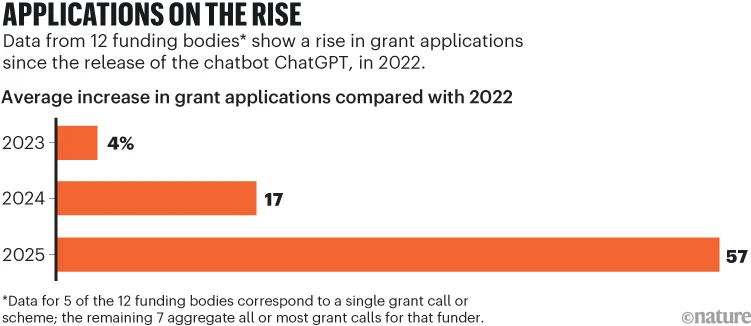
The observed increase is almost certainly driven in large part by the rise of AI. However, the differences in levels of increase also indicate that national, disciplinary and call-specific contexts matter – including overall levels of competitions, resource scarcity and other system-incentives for researchers to increase their application-rates.
The scale of increase in AI use and application volume necessitates an evidence-informed policy and practice response from the research funding community. This project will provide just that. To do so, it will first dig deeper into the data of several funders’ application trends over the past five years (to distinguish between pre- and post-AI trends, and between funder/country specific and overarching trends). Second, we will use experimental methods to better understand the effect of AI-use on application quality (and reviewers’ ability to identify or judge AI-generated proposals). Finally, we will draw from these findings a set of options for funders’ responses to the observed trends, and collaboratively assess each option. The result of this project will be timely recommendations and intelligence to help funders move forward in rapidly changing AI-augmented environments.
Our three specific research objectives are:
- To establish a comparative funder dataset which enables real-time monitoring and comparison of the uptake of AI across different research funding systems, in terms of application volume and quality indicators;
- To test the feasibility of agentic AI workflows for different funding calls and research disciplines, and the extent to which AI-augmented applications are detectable and can compete on a range of quality measures;
- To co-produce with funders a menu of policy, evaluation criteria and process responses, and consider which of these are the most feasible and desirable.
Methodology and Work Plan
This project is structured into four work packages.
1. Mapping the trends
We are analysing application data across participating funders to identify patterns tied to the rise of AI tools, disaggregating trends across demographics and funding schemes. Key areas include:
- Shifts in total application volumes and AI-driven score compression
- Markers of generative AI language and hallucinated citations in proposals
- Topic and methodological convergence, alongside potential reductions in proposal “novelty”
2. Experiments of AI-driven applications in the funding process
We test the capabilities and limitations of AI across the entire funding lifecycle:
- The “Agentic Funding Sandpit”: An extreme test exploring how autonomous AI agents can augment or automate proposal preparation across disciplines.
- Testing in the Field: With researcher and funder consent, select AI-augmented sandbox proposals may be entered into live schemes (ineligible for funding) to benchmark their competitive edge.
3. Evaluating funder options
Building on our empirical findings, we work alongside our funder cohort to co-design policy responses. We explore practical pathways, such as:
- Tailored policies for AI use, from demand management to face-to-face evaluations
- Hybrid evaluation models that balance expert human judgment with automated scale
- Secure sandbox environments that allow testing without compromising researcher IP
Through collaborative mapping workshops, participating funders will evaluate the feasibility, risks, and trade-offs of these options to build actionable policy packages.
4. Practical guidance and future prospects
We will synthesise findings into practical guidance for research funders navigating the AI transition. Because AI capabilities continue to evolve rapidly, this work will lay the foundation for long-term tracking:
- Continuous Monitoring: Regular 6- to 12-month pulse checks on application trends via RoRI’s Funder Data Platform (FDP).
- Future Research: Scoping dedicated follow-up initiatives as part of RoRI’s post-2027 programme.
Project timeline
INFLECTION will run from June 2026 to October 2027.
Outputs
We foresee the following outputs:
The project will also produce a plan for further cross-funder monitoring of application rates
An initial summary of findings (likely as a short RoRI working paper) to serve as the basis for the WP3 workshops
An initial draft booklet of response options to serve as the basis for the WP3 workshops
A final working paper launched at the end of the project, detailing all the project’s finding
The final working paper will be accompanied by a practice-oriented high-gloss short report going through the various response options and reporting on the results of the WP3 workshops, outlining what were concluded to be the most promising options for research funding in the age of AI-driven application
