
November 21, 2025
MetaROR Turns One
A year of open, community-driven reviewing for metaresearch
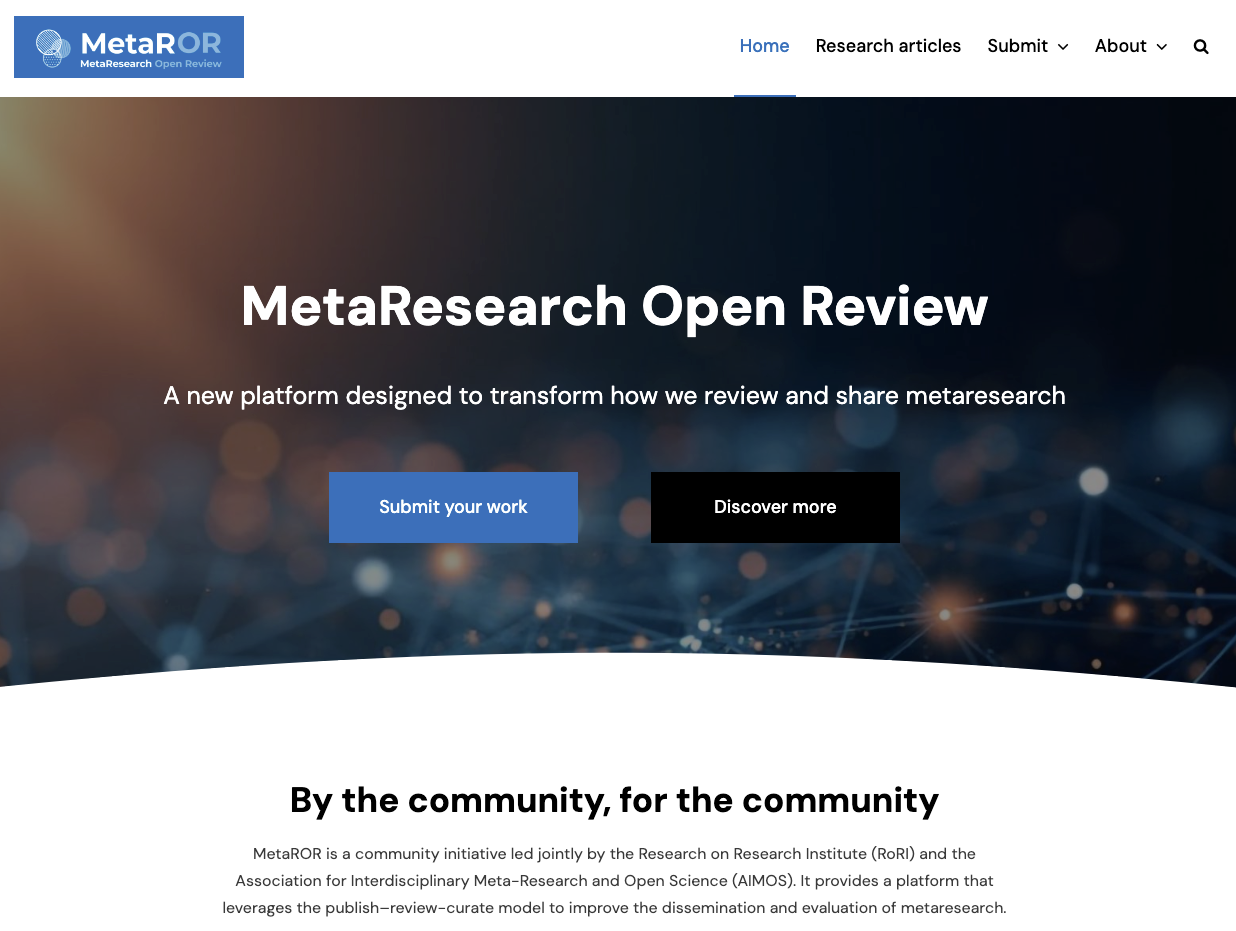
One year ago, the Research on Research Institute (RoRI) and the Association for Interdisciplinary Meta-Research and Open Science (AIMOS) launched MetaROR (MetaResearch Open Review): a community-owned platform designed to transform how metaresearch is shared, reviewed, and evaluated.
Today, as we mark MetaROR’s first anniversary, we’re celebrating what the community has built together: faster, more transparent peer review, growing adoption of open research practices, and a strong sense of collective ownership across the metaresearch community.

Why MetaROR? Addressing key challenges in peer review
In the past five years, metaresearch has expanded rapidly, with new communities, methods, and ambitions. But this growth has also highlighted long-standing challenges: disciplines that rarely interact, paywalls that restrict who can read or publish, mounting pressure on overstretched peer reviewers, and commercial journal practices causing tensions with our community values.
MetaROR was created because metaresearch, more than any other field, has a responsibility to adopt better, more transparent, and more equitable scholarly communication practices.
An innovative model: Publish → Review → Curate
MetaROR operates using the Publish, Review, Curate model. Interest in this model is rapidly growing, with dedicated events and strong support from research funders. MetaROR’s adoption of Publish, Review, Curate builds on pioneering work by eLife, Kotahi, and several other initiatives.
Publish
Authors share their article on a preprint server or repository (e.g., arXiv, bioRxiv, MetaArXiv, PsyArXiv) and then submit their work to MetaROR. This means research is publicly available immediately.
Review
Editors invite expert reviewers.
Reviews are open, citable (with DOIs), and published alongside the article.
Reviewers are encouraged to sign their names but may also remain anonymous.
Curate
Instead of a binary accept/reject decision, editors publish an editorial assessment that synthesises the perspectives of the reviewers on the key strengths and weaknesses of an article.
Alexander Schniedermann, who submitted to MetaROR, said:
The Publish, Review, Curate model brings reviewing and editorial decision making into the open. Its dynamic nature reminds authors to care for what they write and share.
To me, it can become a real game changer in scholarly communication. I got great peer reviews and look forward to revise my manuscript!
Serhii Nazarovets, author of another MetaROR submission, commented:
Open review takes time, but it’s worth every week for the transparency and trust it brings.
One year of MetaROR in numbers
Over the past year, 28 articles were published on MetaROR, with growing interest and support for the platform shown by steady increases in submissions each month.
Across the year, 59 reviewers provided high quality constructive reviews, reporting positive experiences with the process. Their contribution has been invaluable – not only to authors but to the entire community. 90% of the reviewers chose to disclose their identity.
Reviewers consistently completed their assessments on time, with the overwhelming majority of recent articles meeting the target timeframe. This contributed to a noticeably faster reviewing cycle compared with traditional journals; a strong indication that open, community-driven models can be both rigorous and efficient.
MetaROR now has 9 partner journals, with more to follow. The increasing interest shows that journals are recognising the value of transparent reviews and community oversight, especially for interdisciplinary fields like metaresearch.
MetaROR has gained visibility in over a dozen media articles, some of them highlighted here, and has been showcased at various academic events over the year, including the Metascience 2025 conference and the STI-ENID 2025 conference.

Looking ahead
In its first year, MetaROR has shown that community governance, open review, and collaborative curation can meaningfully improve scholarly communication. Over the next year, we will focus on expanding participation, refining our workflows based on community feedback, strengthening our community governance, and developing additional partnerships with journals.
MetaROR is still young, but it has already demonstrated what is possible when researchers take ownership of how their work is shared and evaluated.
